Why Georgia Red Clay Makes Concrete Prep So Important in Canton
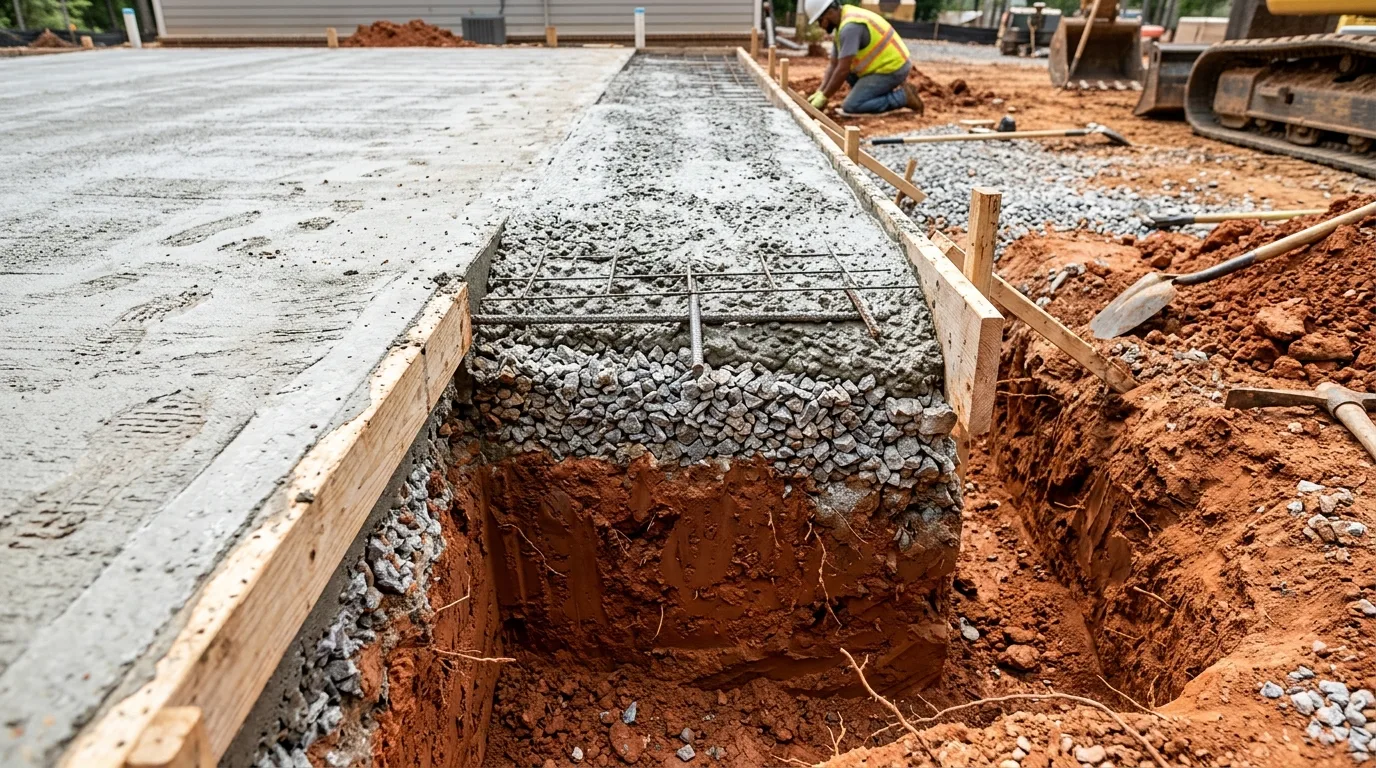
Every Canton homeowner who has had concrete crack prematurely has heard some version of the same explanation after the fact: “the ground shifted.” What they’re rarely told is that this outcome was predictable — and preventable. Georgia’s red clay soil is the most common cause of premature concrete failure in Cherokee County, but it’s not an unavoidable fate. It’s a condition that good base preparation addresses directly. In this post, we cover what makes Canton’s red clay soil so challenging for concrete, what proper base preparation actually looks like, and how to identify whether a contractor is doing the job right.
Concrete Built for Cherokee County's Red Clay
Canton Concrete installs every slab with the base preparation Georgia's Piedmont soils demand. Free estimates.
Why Red Clay Causes Concrete Problems in Canton
Canton sits in Georgia’s Piedmont region, which is dominated by a specific soil type: red clay saprolite. This material — a mix of silicon, aluminum, and iron oxides — is the result of millions of years of weathering on Georgia’s ancient metamorphic rock. It’s the soil responsible for the distinctive red color of Georgia’s dirt, and it’s everywhere in Cherokee County, from the Etowah River corridor through Bridgemill’s subdivisions to the hillside lots of Governors Preserve.
What makes red clay challenging for concrete is its expansive behavior. Unlike sandy soil, which compacts predictably and stays relatively stable with moisture changes, red clay absorbs water and swells — sometimes by 10–15% in volume. When Cherokee County’s rainy spring season arrives, the clay beneath a concrete slab expands upward. When the hot, dry Georgia summer follows, that same clay dries out and contracts, pulling away from the slab edges and creating voids underneath it. Each cycle of expansion and contraction adds cumulative stress to any rigid surface sitting on top of this soil.
This is not a once-in-a-decade problem. It’s an annual cycle that begins the first fall after a concrete slab is poured and continues every year of the slab’s life.
Types / Options: What Happens to Different Concrete Installations
Driveways without base prep: Concrete poured directly on graded red clay with minimal gravel base typically shows stress cracks within 3–7 years. The characteristic crack pattern is parallel to the driveway edges and perpendicular to the direction of traffic — following the direction of most soil movement. Once a crack forms, water infiltrates and accelerates clay movement beneath that section, causing progressive settling.
Patios poured on inadequate base: Patio slabs on red clay often develop corner cracks first — the corners of a slab are the least supported sections when the center of the sub-base settles or voids form. Sloped yard patios are especially vulnerable because gravity pulls soil downhill and away from the lower edge of the slab, leaving it partially unsupported.
Properly installed slabs: Concrete on 4–6 inches of compacted crushed stone has a gravel buffer that doesn’t swell, doesn’t shrink, and provides uniform bearing capacity year-round. The concrete slab rests on stable material, not directly on material that moves with moisture. This is why two driveways on the same street can perform completely differently over 20 years — the one still in good shape likely had better base preparation.
Foundation slabs: Red clay under a home’s foundation creates the same stress cycles. Foundation crack patterns that appear over time — diagonal cracks from door corners, separation at wall-ceiling joints — often trace back to differential clay movement beneath the slab. Areas of the foundation over different soil moisture conditions move at different rates, causing differential settling.
Practical Uses: Recognizing Good vs. Poor Base Preparation
- Excavation depth: Good base prep excavates 6–8 inches total — enough for 4–6 inches of gravel and the concrete slab itself. Inadequate prep may only excavate 3–4 inches, leaving minimal room for gravel.
- Gravel type and compaction: Crushed stone (not round river gravel, which doesn’t compact well) should be spread and compacted in 2-inch lifts, with a plate compactor. A contractor who dumps gravel and drives over it with a truck has not adequately compacted the base.
- Edge treatment: Where the new slab meets existing hardscape or structures, the edge should be formed to prevent the slab from pulling away and creating a water-catching gap over time.
- Rebar vs. wire mesh: Rebar (typically #3 or #4 bar, 18-inch grid) provides better tensile reinforcement than wire mesh and is preferred for driveways in Cherokee County. Wire mesh is acceptable for patios and lighter-duty slabs but should be placed on chairs at the proper height — mesh lying on the ground provides minimal reinforcement.
- Watching your contractor: A legitimate base prep operation involves a excavator or Bobcat taking material out, a truckload of crushed stone going in, and a plate compactor running across the surface in multiple passes. If none of this is happening, the base work is insufficient.
How the Process Works: Correct Concrete Installation in Canton
The first step in any Canton concrete project is assessing what’s actually beneath the existing surface. We probe the sub-base for soft spots, identify any buried debris or fill material (common in some Canton neighborhoods where construction fill was used decades ago), and confirm drainage slope away from any adjacent structures.
Excavation follows — typically 6–8 inches below final grade for a standard 4-inch slab. Crushed stone base is installed in compacted lifts to the specified depth, with careful attention to edge conditions and drainage slope. Rebar or wire mesh is placed at the correct height within the slab before the pour. The concrete pour itself is completed with attention to proper slump (water-to-cement ratio) — overly wet concrete is easier to work but significantly weaker. Joints are placed or cut at the correct intervals for the slab dimensions, and curing compound is applied immediately after finishing to prevent premature moisture loss.
Canton Red Clay Is Our Home Turf
Every Canton Concrete project starts with proper base preparation built for Cherokee County's soils. Call (888) 376-0955.
Cost Factors: What Proper Base Prep Actually Costs
The material and labor for proper base preparation — 4–6 inches of crushed stone, plate compaction, and correct excavation depth — adds $0.75–$1.50 per square foot to the project cost compared to minimal prep. On a 600 sq ft driveway, that’s $450–$900. This is the cost difference between a driveway that lasts 30 years and one that needs replacement in 10 — making it one of the highest-return investments in any concrete project in Cherokee County.
Some contractors omit base prep from their estimates entirely (they do it poorly as standard practice) while others exclude it and charge separately when on-site. Ask every contractor during the estimate: “What is your gravel base specification, and is it included in this quote?” A contractor who doesn’t give you a specific answer isn’t doing the job right.
Frequently Asked Questions
Why does concrete crack in Canton GA?
Most concrete cracking in Canton traces back to Georgia’s red clay soil beneath the slab. Red clay expands when wet and contracts when dry, putting stress on any rigid surface above it. Concrete without proper compacted gravel base has no buffer against this movement. Freeze-thaw cycles in winter can also widen existing cracks by freezing water that infiltrates joints. Proper base preparation, rebar reinforcement, and regular sealing prevent the majority of cracking.
How deep should the gravel base be for a Canton driveway?
For a residential concrete driveway in Canton, 4–6 inches of compacted crushed stone base is the appropriate specification for Cherokee County’s red clay soil. Lighter-duty slabs (patios, walkways) can use 3–4 inches. The key is that the gravel is compacted — uncompacted stone settles and shifts, creating exactly the void problem you’re trying to prevent.
How can I tell if a contractor is skimping on base prep?
Ask for the spec in writing: gravel type, depth, and compaction method. Observe the site before and during the pour — you should see significant material excavated out, crushed stone brought in by truck, and a plate compactor running across the area in multiple passes. If the excavation is shallow and the stone is thin, the base is inadequate regardless of what the contractor says.
Related:
- Concrete driveway cost in Canton GA — 2026 pricing
- Concrete repair in Canton, GA
- Best time of year to pour concrete in Canton GA
Honest Base Prep, Lasting Concrete — That's Canton Concrete
Get a free estimate that includes proper base preparation for your Canton, GA project. Call (888) 376-0955.